
Shock-Boundary Layer Interaction: Shock Trains
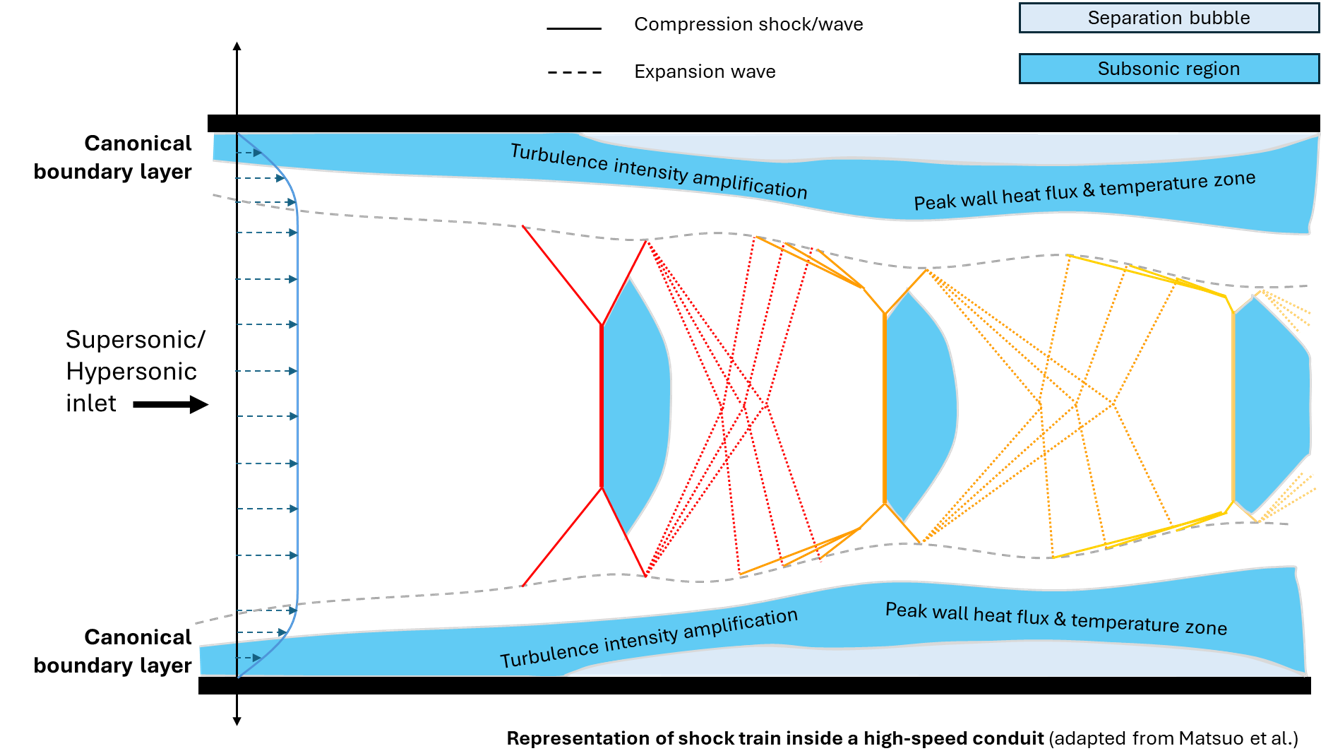
In high-speed internal flows, compression is not achieved through a single normal shock. The flow instead adjusts through a distributed system of interactions that extend over a finite length of the duct. This system, known as a shock train, governs how supersonic flow transitions toward subsonic conditions in practical devices.
Formation
A shock train forms when a sufficiently strong shock interacts with a turbulent boundary layer and induces separation. The initial shock bifurcates, and additional shocks appear downstream in succession. This creates a chained structure of compression, separation, and reattachment, resulting in a gradual pressure rise rather than a discrete jump. The classical notion of a normal shock therefore does not hold in its ideal, discontinuous form in viscous internal flows. (Matsuo et al.)
Each interaction within the train can be interpreted as a localized shock–boundary layer interaction. The leading interaction produces strong separation and rapid thickening of the boundary layer, accompanied by amplification of turbulent stresses and redistribution of momentum. Downstream interactions develop within an already distorted boundary layer, leading to cyclic amplification and attenuation of turbulence before the flow gradually approaches a new equilibrium state. (Sullivan & Gaitonde)
Implications
From a system perspective, the shock train is essential to propulsion performance. In high-speed intakes and isolators, it establishes the pressure and flow conditions required for combustion. This deceleration process is inherently coupled with boundary layer dynamics and is sensitive to geometry, confinement, and imposed back pressure. (Gnani et al.)
This also introduces a critical constraint. The same mechanism that enables controlled compression can destabilize the system. Under adverse conditions, the shock train can propagate upstream and lead to inlet unstart, loss of mass capture, and degradation in engine performance. Interaction with background shocks and expansion waves further modifies the structure, introducing asymmetry, oscillations, and large-scale separation. (Huang et al.)
At its core, a shock train represents compounded shock–boundary layer interaction, where compression, separation, and turbulence evolve as a coupled system that governs the operability of high-speed propulsion devices.
Additional perspectives and insights on these interaction mechanisms are always welcome.
References:
Matsuo et al. : https://lnkd.in/emtZPZyP
Sullivan & Gaitonde : https://lnkd.in/exg5Ktkz
Gnani et al. : https://lnkd.in/ecUJDer7
Huang et al. : https://lnkd.in/e9w_GrDi
